Private Power, Public Purpose by Thomas d'Aquino
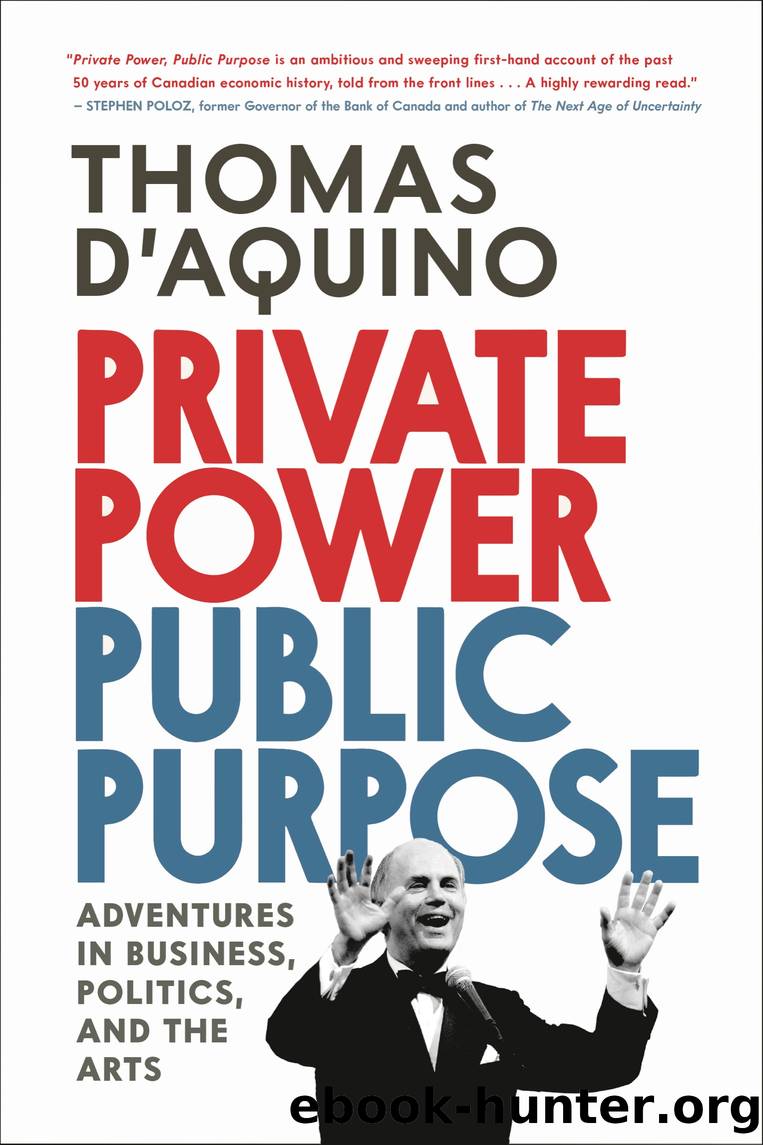
Author:Thomas d'Aquino [d'Aquino, Thomas]
Language: eng
Format: epub
Publisher: McClelland & Stewart
Published: 2023-02-21T00:00:00+00:00
The year 2004 heralded important elections in Canada and in the United States. On June 28, the government of Paul Martin was returned to office with a minority, and in November George W. Bush won a second term. Martinâs minority raised concerns in Council circles that the momentum of naspi might be blunted. This turned out not to be the case.
COUNCIL ON FOREIGN RELATIONS TASK FORCE
One other notable initiative on the North American agenda was launched in 2004. The Council on Foreign Relations, based in New York, sponsored an independent trilateral task force examining the continentâs future. Thanks to Richard Haas, the cerebral president of the Council on Foreign Relations, this was the first time his organization had launched such an undertaking with foreign organizations as partnersâthe Canadian Council of Chief Executives being one, and the other being the Consejo Mexicano de Asuntos Internacionales. I had actively pursued this idea, believing that an eminent multidisciplinary group would complement the work of continental business leaders in a powerful way.
Joining me as the principal catalysts were Professor Robert Pastor of American University, and Andrés Rozental of the Consejo Mexicano, who had served as Mexicoâs ambassador to the United Kingdom. We agreed to serve as task force vice-chairs and as guides. I reached out to former foreign minister John Manley to serve as Canada co-chair; the Americans recruited former Massachusetts governor William Weld to serve as U.S. co-chair; and the Mexicans brought former finance minister Pedro Aspe to the table as the Mexico co-chair. Thirty-one members made up the task forceâa virtual whoâs who of leading thinkers from across the continent.
The task force tabled its report, titled âBuilding a North American Community,â in May 2005 and made the following key recommendations: create the institutions necessary to sustain a North American community; immediately create a unified North American Border Action Plan; develop a secure North American border pass with biometric identifiers; enhance law-enforcement cooperation; expand defence cooperation; adopt a common external tariff; develop a North American energy and natural resource security strategy; stimulate economic growth in Mexico; deepen trilateral educational ties; and establish an annual summit of North American leaders.
A reading of the Council on Foreign Relations task force report leads to two conclusions. The first is that the work of the Councilâs naspi project, launched in 2003, had a significant impact on our task force deliberations and recommendations. The second is that the task force recommendations broadly matched the boldness of naspiâs ambitions. In my view, the real significance of the work of the task force is that it validated, from the perspective of a group of eminent thinkers from across the continent, what until then had been largely a Council-driven idea.
Download
This site does not store any files on its server. We only index and link to content provided by other sites. Please contact the content providers to delete copyright contents if any and email us, we'll remove relevant links or contents immediately.
| Arms Control | Diplomacy |
| Security | Trades & Tariffs |
| Treaties | African |
| Asian | Australian & Oceanian |
| Canadian | Caribbean & Latin American |
| European | Middle Eastern |
| Russian & Former Soviet Union |
The Secret History by Donna Tartt(19089)
The Social Justice Warrior Handbook by Lisa De Pasquale(12190)
Thirteen Reasons Why by Jay Asher(8910)
This Is How You Lose Her by Junot Diaz(6887)
Weapons of Math Destruction by Cathy O'Neil(6280)
Zero to One by Peter Thiel(5802)
Beartown by Fredrik Backman(5754)
The Myth of the Strong Leader by Archie Brown(5508)
The Fire Next Time by James Baldwin(5446)
How Democracies Die by Steven Levitsky & Daniel Ziblatt(5219)
Promise Me, Dad by Joe Biden(5153)
Stone's Rules by Roger Stone(5088)
A Higher Loyalty: Truth, Lies, and Leadership by James Comey(4964)
100 Deadly Skills by Clint Emerson(4925)
Rise and Kill First by Ronen Bergman(4789)
Secrecy World by Jake Bernstein(4753)
The David Icke Guide to the Global Conspiracy (and how to end it) by David Icke(4720)
The Farm by Tom Rob Smith(4513)
The Doomsday Machine by Daniel Ellsberg(4490)
